REVIEW · SAN FRANCISCO
Emperor Norton’s Fantastic San Francisco Time Machine
Book on Viator →Operated by Emperor Norton's Fantastic San Francisco Time Machine · Bookable on Viator
Emperor Norton makes San Francisco time travel possible. I love how Emperor Norton leads you through downtown in full character, turning everyday corners into story points you can actually see. I also love the way the tour threads the 1906 earthquake into landmark stops like Lotta’s Fountain. One consideration: you’re walking about two miles at a leisurely pace, so comfy shoes matter.
This is a small-group experience with a mobile ticket and a maximum of 10 people, so you get room to ask questions and actually hear the guide. For about two hours starting at Union Square and ending at Old St. Mary’s Cathedral, it’s an easy way to get oriented without turning the day into a long production. Masks and social distancing are required, so plan accordingly.
In This Review
- Key highlights you’ll feel right away
- Starting at Union Square, where the stories begin
- Barbary Coast Trail: a full hour of walking through famous trouble
- Union Square and the Dewey Monument: why this plaza has weight
- Jackson Square: the darker angle of the Barbary Coast story
- Maiden Lane: from glamorous name to brothel-lined past
- Lotta’s Fountain: a meeting place since 1875—and earthquake memory
- Portsmouth Square: the birthplace story and Chinatown’s living room
- Old Saint Mary’s Cathedral: the Emperor’s final stop
- Price and value: why $20 feels fair for what you get
- Pacing, group size, and what to wear
- Who this tour is for (and who it might not be)
- Smart add-ons after the tour
- Should you book Emperor Norton’s Fantastic San Francisco Time Machine?
- FAQ
- How long is Emperor Norton’s Fantastic San Francisco Time Machine?
- How much does the tour cost?
- Where does the tour start and where does it end?
- Is the tour a walking tour?
- What’s included in the ticket price?
- What is not included?
- Is there a group size limit?
- Do I need a mobile ticket?
- Are masks and social distancing required?
- Are service animals allowed?
Key highlights you’ll feel right away

- A guide in costume as Emperor Norton, keeping the vibe playful while still covering real places
- Barbary Coast Trail for an hour of walking through multiple historic sites
- Landmarks tied together: Union Square, Jackson Square, Maiden Lane, Lotta’s Fountain, Portsmouth Square
- Lotta’s Fountain stories including Lotta Crabtree, Lola Montez, and Luisa Tetrazzini
- A short finish at Old St. Mary’s Cathedral with the Emperor’s passing as the closing note
- Good value at $20 with taxes and fees handled and multiple stops included
Starting at Union Square, where the stories begin
You meet at Union Square, and that choice makes sense. This is one of those hubs where locals and visitors all mix, so it’s a natural place to start a “time machine” walk. From here, the guide sets the tone fast: you’re not just hearing dates and names. You’re learning how people in the 1800s would have seen the city, and how the streets still hold clues.
The Emperor Norton character also does something practical. When someone dresses the part and speaks with that swagger, you remember details better. The guide isn’t stuck in a lecture mode. You get the history with a bit of theater, and it keeps the pace light even when the topic gets serious.
And since the group max is 10, you’re less likely to be swallowed by the crowd. You can look around, keep up with the route, and still catch the stories.
You can also read our reviews of more tours and experiences in San Francisco.


Barbary Coast Trail: a full hour of walking through famous trouble
The tour’s first major chunk is the Barbary Coast Trail, and it’s the part that makes this feel like a real “walk into the past.” You spend about an hour here, with the trail winding through a run of historical sites rather than stopping and starting every few minutes.
The big idea is simple: the Barbary Coast is not just a label. It’s a set of locations that connect to the San Francisco of another era. The guide ties what you’re seeing to what the area meant, so it stops feeling abstract. One of the best moments is when the guide helps you understand where the city ended and the water began back then, so you can picture the coastline in your head as you move along.
If you like your history tied to street-level reality, this is the part you’ll likely remember later when you’re just wandering on your own. It also helps you get your bearings fast, because the trail gives you a mental map of how the area fits into today’s layout.
Union Square and the Dewey Monument: why this plaza has weight
After the Barbary Coast Trail, you shift to Union Square for about 20 minutes. This stop is built around the history of Union Square itself and the Dewey Monument, which gives the area a clearer backstory than you’d get from casual sightseeing.
Union Square can feel like a postcard spot—clean, busy, and modern. The tour reframes it. The guide connects the plaza to how San Francisco grew and how public spaces were used and understood. Even if you’ve walked through Union Square a dozen times, you’ll likely catch something you missed: the why behind the setting, not just what it looks like.
This is a good mid-tour pause, too. You get a breather without losing momentum.
Jackson Square: the darker angle of the Barbary Coast story
Jackson Square comes next with a longer stop of about 30 minutes. Here, the focus is the notorious Barbary Coast backstory. This is where the tour starts to feel more like a narrative, not just a sequence of landmarks.
It’s also one of the tour’s smarter design choices. By splitting the Barbary Coast theme across two stops—one broad walking section first, then a focused square after—you get both the sweep and the detail. The guide can point out what makes Jackson Square fit into that larger story, and you’re not trying to hold everything in your head at once.
If you’re the type who likes context—why people came, where the energy went, and how the city’s reputation formed—this stop delivers.
Maiden Lane: from glamorous name to brothel-lined past
Maiden Lane is a shorter stop at about 15 minutes, but it carries strong storytelling punch. The tour highlights how Maiden Lane used to be lined with brothels and leans into the contrast between the street’s name and what it once represented.
This is exactly the kind of stop that makes the tour worth it, even if you only care about a handful of sites. The guide takes something you might treat as a shopping-and-dining connector and turns it into a place with a specific social past.
You don’t need deep interest in Victorian-era San Francisco to enjoy it. The way the guide frames it makes the city’s evolution feel more human. You can almost hear the everyday talk and see how the street functioned.






Lotta’s Fountain: a meeting place since 1875—and earthquake memory
Lotta’s Fountain is one of the most memorable stops, and the tour gives it about 20 minutes. You learn that it’s been a gathering place since 1875, and you connect it to the yearly earthquake commemoration. That combination—social life plus disaster memory—is what gives this stop real emotional structure.
The guide also includes stories about buildings that survived the earthquake, along with three notable names tied to the area’s cultural life: Lotta Crabtree, Lola Montez, and Luisa Tetrazzini. It’s a mix of place and people, and it helps you understand why certain landmarks keep showing up in the city’s storytelling.
One practical takeaway: this is where you learn to look at a public fountain and see it as an anchor. Not just a photo spot. A reference point. When you walk away, you’ll likely notice other “anchors” across the city, because the tour trains you to read space that way.
If you’re sensitive to heavier topics, you should know that the earthquake theme is part of the tour’s arc. The tone you get depends on the guide’s storytelling style, but the route doesn’t avoid the subject.
Portsmouth Square: the birthplace story and Chinatown’s living room
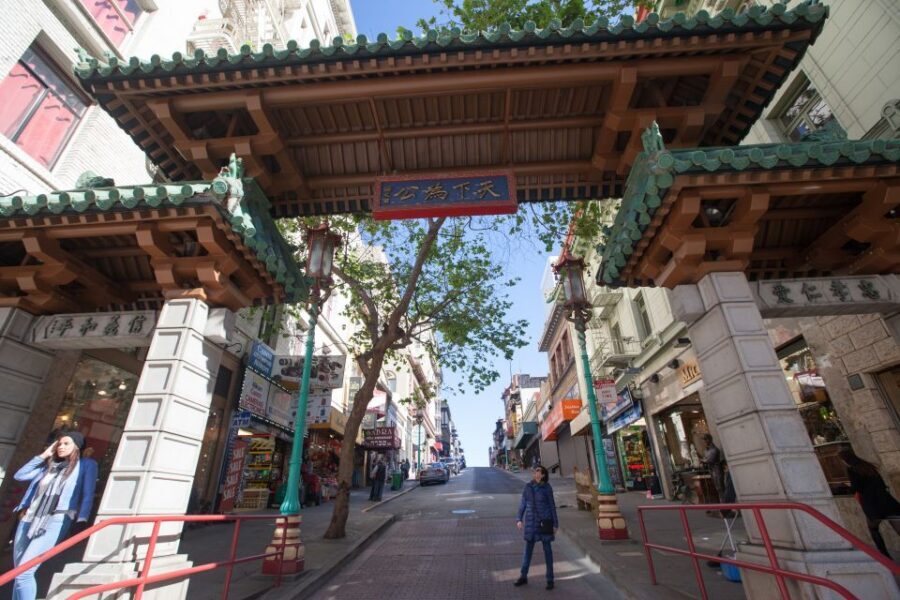
Portsmouth Square gets about 15 minutes, and the tour uses it for two strong themes. First, it’s described as the birthplace of San Francisco. Second, it connects to Chinatown as its living room.
That pairing does something clever: it links the origin story to the ongoing neighborhood identity. You’re not just learning a date-based fact. You’re learning how a place continues to matter through daily life.
For me, the value of stopping here is that it balances the earlier portions of the tour. After Barbary Coast and the darker edges of the city’s reputation, Portsmouth Square feels like a reset—more community-focused, more grounded.
It’s also a good moment to slow down mentally. You’ve been moving through story-heavy stops, so this one gives you a place to take it in and absorb what you’ve learned about how the city became itself.
Old Saint Mary’s Cathedral: the Emperor’s final stop
The tour ends at Old St. Mary’s Cathedral, with about 5 minutes on site. This last bit focuses on the cathedral’s history and the passing of the Emperor, which gives the walking loop a clear finish.
Short ending stops can sometimes feel rushed, but here it works because the tour has been building a character-driven narrative. You’re not just finishing at another landmark. You’re closing the story arc, and the guide uses the final site to give you that last “time machine” feeling before you break away.
If you’re the type who likes an ending with meaning, this conclusion will likely land. And since the meeting and ending points are clearly defined, you can plan the rest of your day without stress.
Price and value: why $20 feels fair for what you get
At $20 for about two hours, this tour sits in the sweet spot for value in San Francisco. It’s not a long multi-day commitment. You get a focused route with multiple major landmarks and a guide who leads from start to finish.
Also, the price includes all taxes, fees, and handling charges, which makes it simpler. You’re not scrambling later for add-ons. And since some stops include admission tickets while others are free, you get a route that feels “packed” rather than padded.
The biggest value isn’t just the sites. It’s how the guide links them into a single storyline. That’s what turns a walk into something you’ll remember, and it’s why this can work for both first-timers and locals.
Pacing, group size, and what to wear
The tour is described as a leisurely walk at around two miles total. That makes it approachable for many people, and it fits well if you want a history hit without turning the day into a hike.
Still, you should plan around being on your feet. A two-mile walk isn’t huge, but uneven sidewalks and real city standing time can add up. Comfortable shoes beat fashion here. If you’re planning other activities the same day, schedule this earlier so you can still enjoy the rest.
With a maximum of 10 travelers, the pace stays manageable. You’re not getting shoved along, and the guide has enough attention bandwidth to keep the stories clear.
Masks and social distancing are required, so bring your mask and plan to move through indoor/outdoor spaces with current local rules in mind.
Who this tour is for (and who it might not be)
This is great for you if you like:
- A storytelling guide who uses character to connect the dots
- Street-level history tied to named places like Union Square and Lotta’s Fountain
- A short, city-orienting walk that still covers big themes like the Barbary Coast and the 1906 earthquake
It’s also a strong choice if you live in San Francisco or know it well. The tour’s pace and the way the Emperor frames familiar areas can reveal new details, including how you understand where the city met the water back then.
It may not be your best fit if:
- You want zero walking and want to sit the whole time
- You dislike character-based guides and prefer strictly factual narration without a theatrical tone
Smart add-ons after the tour
One of the best perks of doing a guided walk in a compact two-hour window is that you often leave with practical local direction. The guide’s recommendations can be useful for the next stop in your day, including lunch advice and specific snacks tied to the city’s classic food culture.
So after you finish near Old St. Mary’s Cathedral, you’re set up to keep exploring nearby areas while the city’s story is still fresh in your head.
Should you book Emperor Norton’s Fantastic San Francisco Time Machine?
If you want a history lesson that feels like a walk through a living comic panel of San Francisco, I’d book it. The price is reasonable, the group size stays small, and the route hits landmarks you’ll recognize even if this is your first time in the city.
You’ll get the Barbary Coast Trail for a full hour, a narrative through Jackson Square and Maiden Lane, and then a more reflective turn at Lotta’s Fountain with the earthquake commemoration theme and named cultural figures. The ending at Old St. Mary’s Cathedral gives you a satisfying close.
Go if you’re okay walking about two miles, and bring a mask. If you want compact, character-led storytelling tied to real locations, this tour is an easy yes.
FAQ
How long is Emperor Norton’s Fantastic San Francisco Time Machine?
It runs for about 2 hours.
How much does the tour cost?
The price is $20.
Where does the tour start and where does it end?
It starts at Union Square, San Francisco, CA, USA, and ends at Old St. Mary’s Cathedral at 660 California St, San Francisco, CA 94108.
Is the tour a walking tour?
Yes. You’ll walk at a leisurely pace for around two miles.
What’s included in the ticket price?
A professional guide is included, along with all taxes, fees, and handling charges.
What is not included?
Food and drinks are not included, and there is no hotel pickup or drop-off.
Is there a group size limit?
Yes. The tour has a maximum of 10 travelers.
Do I need a mobile ticket?
Yes. The tour includes a mobile ticket.
Are masks and social distancing required?
Masks and social distancing are required.
Are service animals allowed?
Yes, service animals are allowed.