REVIEW · SAN FRANCISCO
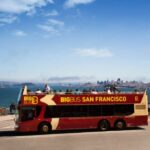
City Sightseeing San Francisco Hop-On Hop-Off Bus Tour
Book on Viator →Operated by City Sightseeing Ltd - USA and Middle East · Bookable on Viator
Cable cars are optional here. You still get big views.
What makes this hop-on hop-off bus tour interesting is the way it stitches together San Francisco’s core sights into a smooth 2-hour ride, letting you get on and off when something catches your eye. I like the live English guide and the fast-paced route with lots of photo opportunities. I also like the flexibility of hop-on hop-off stops, so you’re not forced into one long, sit-still plan. One drawback to consider: the quality of the ride experience can vary, and one guest reported issues with guide volume, very brief sight talk, and difficulty managing a walker when boarding.
Onboard, I love that you get free Wi‑Fi and a downloadable audio guide app in 13 languages. That’s useful when the live narration is too short for your liking, or when you want to read the context at your own pace. The tradeoff is simple: you must bring your own smartphone and earphones, because headphones aren’t included.
In This Review
- Key things to know before you ride
- Union Square to Powell-Hyde: the jump-start to your city day
- Chinatown and the Financial District: quick culture and street geometry
- North Beach to the waterfront: Embarcadero and the Pier 35 setup
- Fisherman’s Wharf and Ghirardelli Square: iconic stops with short attention spans
- Fort Mason to Lombard Street: Bay views plus one famous bend
- Palace of Fine Arts to Golden Gate Bridge: the classic photo-to-math connection
- Golden Gate Park: Japanese Tea Garden, De Young, Cal Academy in one sweep
- Haight-Ashbury and Alamo Square area: neighborhood color with minimal effort
- Civic Center stop: finishing with a practical reset point
- Live guide vs audio app: how to make the narration work for you
- Value check: what you’re really paying for (and how to get your money’s worth)
- Should you book this bus tour?
- FAQ
- How long is the San Francisco Hop-On Hop-Off Bus Tour?
- How often do the buses depart?
- Where do I start, and what time is the first and last departure?
- Can I use a mobile ticket or a printed voucher?
- What do I get for onboard amenities and guides?
- Do I need to bring headphones for the audio guide app?
- Does the bus stop directly at Pier 39?
- Are food, drinks, and attraction entry fees included?
- Is hotel pickup and drop-off included?
Key things to know before you ride
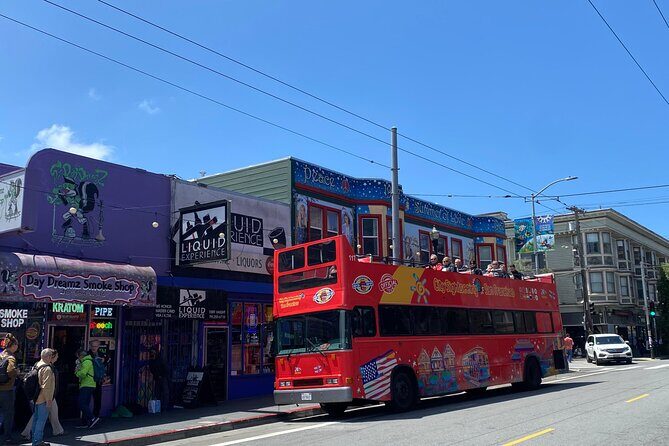
- Buses run frequently (about every 40 minutes), which helps if you hop off to walk and grab a photo.
- You get live guiding in English plus an audio app for extra commentary in 13 languages.
- You can use mobile or printed vouchers at any stop, which makes this easy for on-the-day changes.
- Pier 39 takes a short walk: the bus drops you near Pier 35, then it’s about 100 metres to Pier 39.
- Your route is built for quick hits across Union Square, Chinatown, the waterfront, Golden Gate Park, and neighborhood streets.
Union Square to Powell-Hyde: the jump-start to your city day
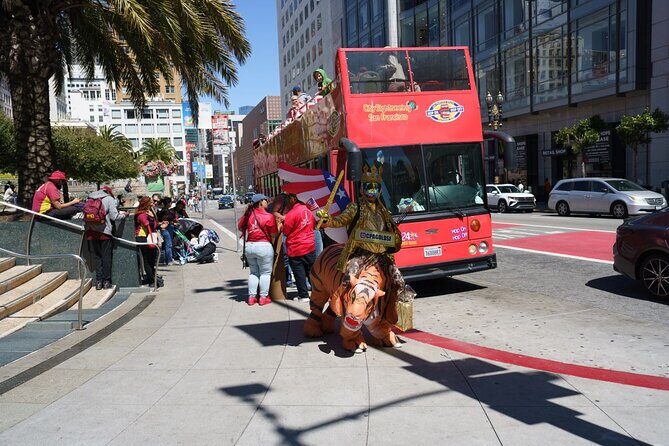
Most San Francisco bus tours either start too late or cover too little. This one starts at Stop 1 near Union Square / Geary Street & Powell Street, with the first departure at 10:15am and the last at 5:30pm. If you want an efficient first taste of the city, this is a smart anchor point because you’re already close to a lot of central activity.
As the bus begins, you’ll get a sense of the city’s hills and grid. Even if you don’t plan to get off right away, it helps you calibrate directions fast—so later, when you walk a few blocks on your own, you’re not constantly guessing.
Practical tip: if you’re feeling jet lag or fogged-in by jet-lag logic, staying on the bus for the first stretch is still valuable. You can watch traffic flow, learn where the waterfront sits in relation to downtown, and decide which stops are worth the effort to get off.
You can also read our reviews of more city tours in San Francisco


Chinatown and the Financial District: quick culture and street geometry
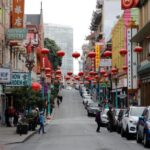
Your next two anchor stops land you in Chinatown and then into the Financial District. Stop 2 is near Tian Xia Wei Gong at Bush & Grant, which is a recognizable landmark name tied to the area’s temple-and-street energy. This is the part of the day where you’ll notice signage, storefront density, and the “block-by-block” rhythm that makes Chinatown feel like its own mini-city.
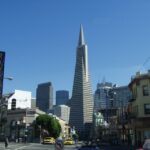
Stop 3 takes you to 773 Kearny St in the Financial District, right by a Hilton. Kearny Street is all about scale: wide streets, tall buildings, and a different pace. Even if you don’t hop off, the view shift from Chinatown streets to the Financial District’s high-rise backdrop can help you understand how close these different worlds sit.
A consideration: since your total ride time is about 2 hours, you can’t treat every stop as a long sightseeing program. For these two areas, I recommend a “look, snap, and decide” approach—get off only if you’ve already picked what you want to do there.
North Beach to the waterfront: Embarcadero and the Pier 35 setup
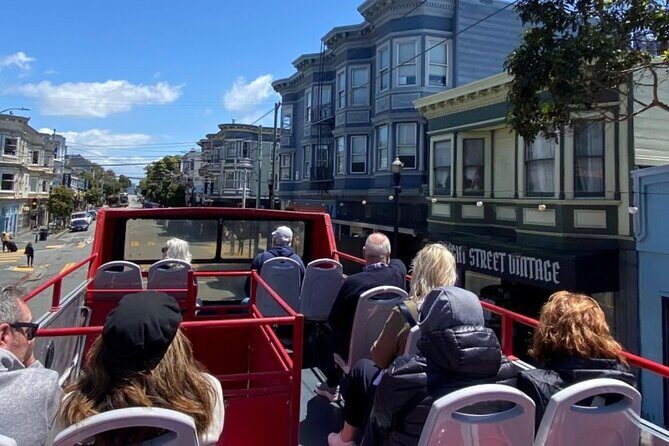
Stop 4 is in North Beach, the neighborhood that often gets paired with romantic Italian-mood imagery—but on a bus tour like this, the real win is simpler: you’re seeing the city’s old-school streets and the kind of hillside blocks that create great angles for photos.
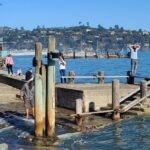
Then you roll to the water at Stop 5: 1440 The Embarcadero (Pier 35, 1914). The Embarcadero stretch is where San Francisco starts feeling like it belongs to the Pacific. The bus gives you a moving perspective, and when you hop off, you can walk a bit and pick up that classic waterfront air.
One detail I think matters: the bus does not stop right next to Pier 39. If Pier 39 is on your list, you should hop off at Stop 6 and walk about 100 metres from Pier 35 to Pier 39. This is quick, but it’s also easy to miss if you assume the stop is right at the gates.
If you’re planning snacks, look for places around the waterfront areas on your own timing. Entry tickets and food aren’t included, so you’ll be making those choices separately anyway.
Fisherman’s Wharf and Ghirardelli Square: iconic stops with short attention spans
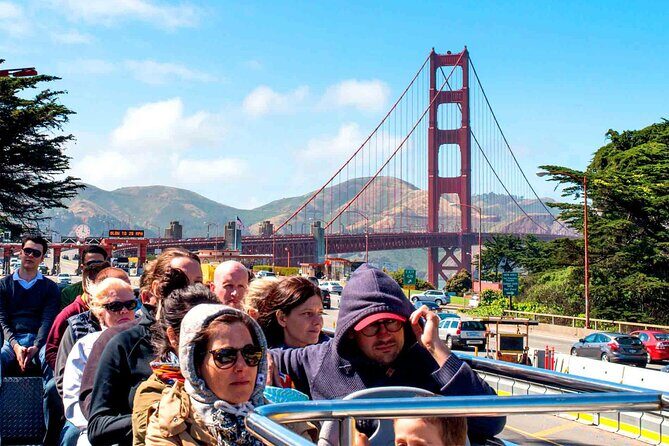
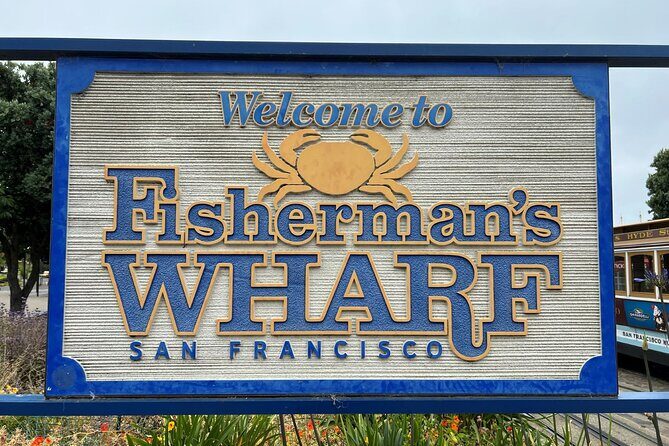
Stop 7 is Fisherman’s Wharf, with a marked location at LibertyX Bitcoin ATM. That ATM reference isn’t for your sightseeing brain—it’s just the practical pin the operator uses to get you off at the right place. The sightseeing value is the surrounding waterfront energy and the fact that you’re right in the tourist-and-water zone where you’ll usually find plenty to look at.
Stop 8 is Tea Square at Ghirardelli Square. This is a great stop to get off for a break because it’s a compact, walkable area where your “I just need something to do for 30–45 minutes” plan can work. You’ll also be surrounded by the kind of storefront scene that makes it easy to people-watch while you rest your legs.
A balanced take: this part of the route is more about famous stops than quiet discovery. If you’re chasing solitude, you’ll probably prefer Golden Gate Park later. If you want easy, recognizable landmarks with minimal navigation, these waterfront stops deliver.
Fort Mason to Lombard Street: Bay views plus one famous bend
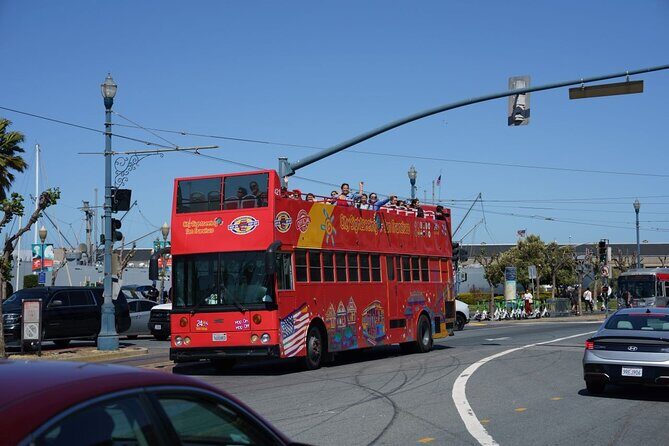
At Stop 9 (Van Ness Ave & North Point St) you’re set down near Fort Mason. This is where the bus gives you another type of payoff: open sightlines and a bay-oriented feel. Even if you only stay on the bus, the visual shift is clear. If you hop off, you’ll have room to stretch your legs and get photos without fighting for the best angle.
Then comes Stop 10 at Maker & Moss for Lombard Street (Van Ness & Lombard). Lombard Street is one of those places where you don’t need a long explanation to know what you’re going for. The value of this stop is that the bus places you in the right corridor so you can walk to the view point without doing complex map work.
Time-management thought: because the buses run about every 40 minutes, it’s easy to treat Lombard Street like a “drop in for the photo” moment. You don’t need a long schedule—just be mindful of the time it takes to walk back to your stop.




Palace of Fine Arts to Golden Gate Bridge: the classic photo-to-math connection
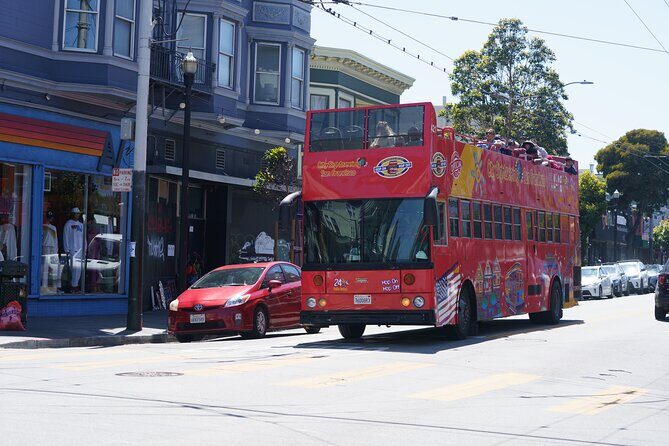
Stop 11 sets you up at Palace of Fine Arts, with the stop marker referencing San Francisco Deluxe sightseeing (Palace-of-fine-Arts). This is one of the easiest places to appreciate from inside a tour plan because the area is visually striking and quick to understand. If you want one stop that feels like an instant “oh wow” moment, Palace of Fine Arts is a strong candidate.
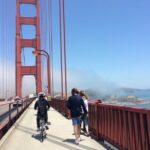
Then you head toward the biggest skyline icon on the list: Stop 12 (Golden Gate Bridge – Marin County). The stop location is described as US‑101 Off-Ramp / Sausalito Lateral Rd, which tells you the operator’s strategy: you’ll be positioned near a logical viewpoint access point rather than right at the middle of pedestrian chaos.
The bridge segment is where the audio guide can be handy because it helps you track what you’re seeing while you’re moving. On a hill city like San Francisco, being able to attach narration to visuals beats guessing.
One caution: the tour timeline is tight. If you want more than a quick viewpoint and a few photos, you’ll have to be selective. Golden Gate Bridge is usually worth it, but it depends on your personal priorities.
Golden Gate Park: Japanese Tea Garden, De Young, Cal Academy in one sweep
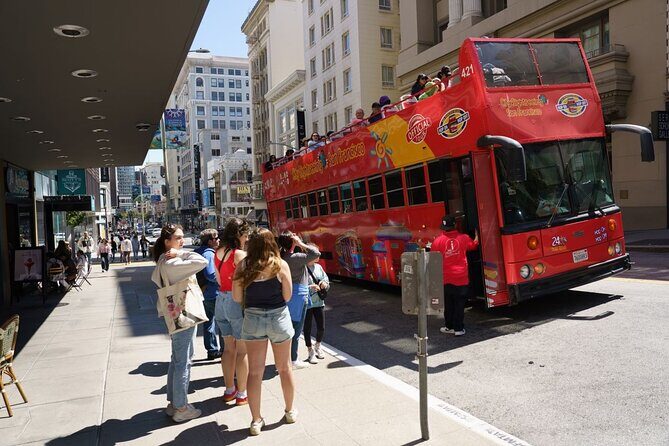
Stop 13 puts you in Golden Gate Park at Fulton Street & 8th Avenue. Stop 14 expands that with de Young / Tea Garden, pointing you to the Japanese Tea Garden, DeYoung Museum, and JFK Drive. Stop 15 is for Cal Academy at the Music Concourse and California Academy of Science.
This is the smartest part of the tour for people who want variety without committing to a full-day park plan. Golden Gate Park can be huge, but the bus route gives you three different “flavors” in a row:
- a garden-and-calm angle (Japanese Tea Garden),
- a museum-and-architecture stop (DeYoung),
- and a science/museum option (California Academy of Science).
What I’d do if I were planning your ride: choose one of these stops for deeper exploring. If you try to do all three, your 2-hour window can vanish fast, and you may end up racing between locations rather than enjoying them.
Also, Golden Gate Park can feel weather-challenging compared to downtown. If fog rolls in, plan for layers and expect it to be cooler near the water and open viewpoints.
Haight-Ashbury and Alamo Square area: neighborhood color with minimal effort
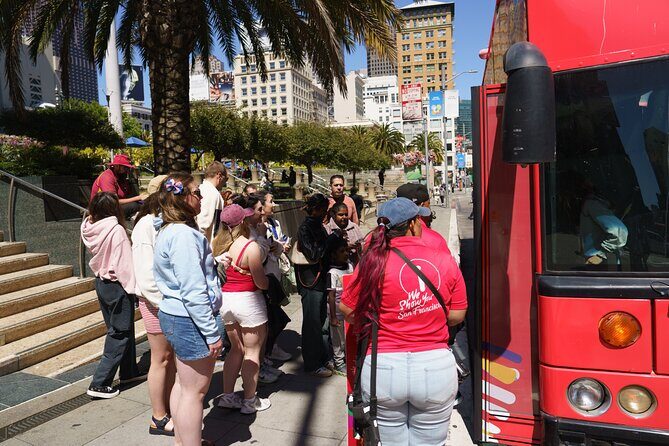
Stop 16 is Haight St & Clayton St, your entry point into Haight-Ashbury. Stop 17 is Divisadero St & Hayes St for Alamo Square. These stops are a good match for the hop-on hop-off format because neighborhood sightseeing often comes down to walking a few blocks, looking at street scenes, and soaking up the vibe.
The advantage here is that the bus does the heavy lifting. You don’t need to figure out how to get from the park area to the neighborhoods on your own. You just hop off and do a short self-guided look.
A consideration: if you’re visiting in a busy period, the sidewalk crowd around popular neighborhood viewpoints can make it hard to stop for long. For this reason, I recommend short walks and flexible timing rather than a rigid checklist.
Civic Center stop: finishing with a practical reset point
Stop 18 is Mcallister St & Larkin St for Civic Center. This works well as a “wrap the ride” landing zone because it’s central enough to connect later to other plans you might have—especially if you want to end near shopping or transit.
By the time you reach the end of the loop, you’ll likely understand what the route is doing: downtown sights first, waterfront next, then Golden Gate Park, then neighborhoods. Civic Center is a clean way to exit with your bearings improved.
If you’re using this tour as an organizing tool for the day, don’t underestimate this final stop. Even a short walk around Civic Center can help you understand the city’s layout and plan the next part of your itinerary.
Live guide vs audio app: how to make the narration work for you
You get a fun and friendly live tour guide on all buses (English), plus an audio guide app in 13 languages. That setup is great in theory because it gives you two ways to learn: real-time comments from the guide and extra detail through the app.
Here’s my practical advice: if you care a lot about storytelling, treat the audio app as your main tool. The app requires your own smartphone and earphones (headphones aren’t included), but it lets you control how you listen. That can be especially helpful if the live narration feels too brief for what you want.
Also, keep expectations grounded. One report mentioned a guide keeping music loud and requesting tips, with sight descriptions that were very short. That doesn’t mean every ride is the same, but it does mean you should be ready to steer your own experience. Earphones and the audio app are your safety net.
Value check: what you’re really paying for (and how to get your money’s worth)
No price is listed here, so I can’t compare costs directly. But I can still tell you how to judge value based on what’s included.
This tour is strongest if you want:
- a 2-hour orientation to major San Francisco areas,
- convenience (frequent stops and hop-on hop-off access),
- onboard comfort add-ons like free Wi‑Fi,
- and layered learning through live English guiding plus a multilingual audio app.
It’s weaker if you’re expecting deep, slow museum-level commentary at every stop, because the ride is built for movement. It’s also weaker if you rely on step-free boarding, since one guest reported the bus was not set up well for a walker when getting on and off.
How to maximize value:
- Plan to get off at just 2–4 stops during the 2-hour window.
- If Pier 39 matters, remember the 100-metre walk from Pier 35.
- Bring your own earphones so you can switch to the app when you want fuller context.
Should you book this bus tour?
I’d book this if you want a fast, structured way to see a lot of San Francisco without doing route-planning gymnastics. It’s especially handy for first-timers, people with limited time, and anyone who likes choosing their own pace between stops.
I’d think twice if you want long, detailed stop narration, or if accessibility for a walker or similar mobility gear is a priority. In that case, I’d recommend confirming boarding support with the operator first, since a reported experience wasn’t smooth.
If you’re flexible, bring earphones, and pick a couple of stops that match your interests, this tour can be a solid way to get your bearings fast—and then spend the rest of your day exactly how you want.
FAQ
How long is the San Francisco Hop-On Hop-Off Bus Tour?
The tour is approximately 2 hours.
How often do the buses depart?
Buses run every 40 minutes.
Where do I start, and what time is the first and last departure?
The first departure from Stop 1 is 10:15am, and the last departure from Stop 1 is 5:30pm.
Can I use a mobile ticket or a printed voucher?
Yes. Mobile and printed paper vouchers are both accepted, and you can redeem them at any stop along the route.
What do I get for onboard amenities and guides?
You get free Wi‑Fi onboard, a live tour guide in English, and an audio guide app with commentary in 13 languages.
Do I need to bring headphones for the audio guide app?
Yes. Headphones are not included, so you need your own earphones and your smartphone to use the audio guide app.
Does the bus stop directly at Pier 39?
No. For Pier 39, you should hop off at Stop 6 and walk approximately 100 metres from Pier 35 to Pier 39.
Are food, drinks, and attraction entry fees included?
No. Food and drink aren’t included, and entry to attractions is not included.
Is hotel pickup and drop-off included?
No. Hotel pickup and drop-off are not included.